
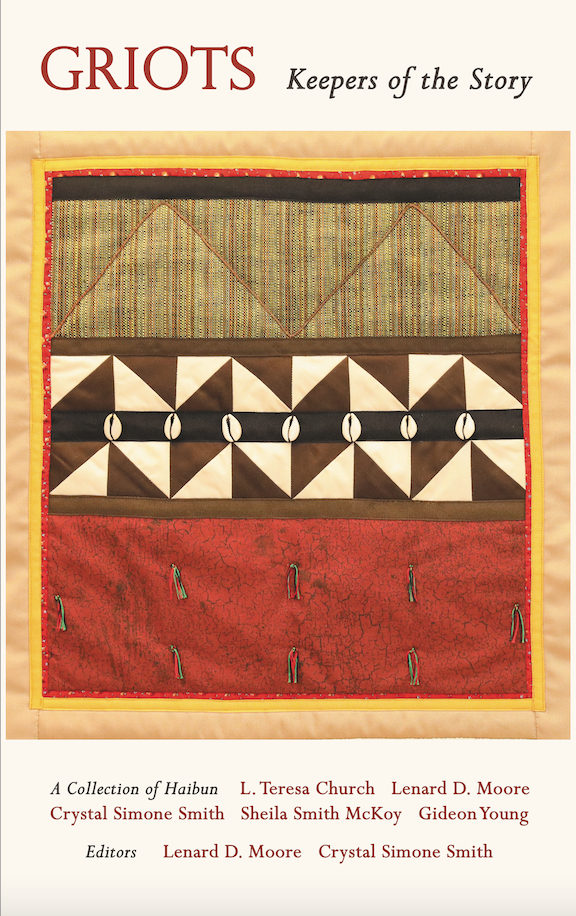
Griots: Keepers of the Story
Publisher: Unicorn PressISBN: 978-0-87775-230-1Genre: Poetry, HaibanPrice: $18.00“Griots: Keepers of the Story is an excellent collection of haibun by the five fine poets and members of the well-known Carolina African American Writers’ Collective. As a quintet, they distinguish themselves as a collective voice that unifies a narrative perspective through the integration of the Japanese poetic form and the African American experiences. Their voice is singular and emotional with a rich accumulation of images to vivify the language and expression. Each poem offers a moment to find delightful surprises for the heart and the eye.”
—JOHN ZHENG, author of African American Haiku
This book was edited by Crystal Simone Smith, an award-winning poet and educator. She is the author of Runagate: Songs of the Freedom Bound (Duke University Press, 2025), winner of the 2025 Roanoke-Chowan Poetry Award, and Dark Testament (Henry Holt, 2023). In 2022, her collection of haiku, Ebbing Shore, won The Haiku Foundation Touchstone Distinguished Book Award. Smith is the recipient a Duke Humanities Unbounded Fellowship and her work has appeared in numerous journals including POETRY Magazine, Harper’s Magazine, Rattle, Frogpond, Modern Haiku and The Heron’s Nest. She teaches in The Writing and Rhetoric Program at Duke University and is the current president of the Haiku Society of America.
Co-Editor Lenard D. Moore is the Founder & Executive Director of the Carolina African American Writers’ Collective. Moore is a writer of more than 20 forms of poetry, drama, essays, and literary criticism, and has been writing and publishing haiku for more than 20 years. He was awarded the Haiku Museum of Tokyo Award in 2003, 1994, and 1983. Three of his poetry collections, Desert Storm: A Brief History (1993), Gathering at the Crossroads: The Million Man March (2003), and A Million Shadows at Noon (2023) offer full narratives unfolded entirely in haiku. He served as the first African American President of the Haiku Society of America (2008 and 2009).
Reviews
Together, these poets’ haibun weave a rich tapestry. With only a couple of exceptions, all the pieces follow the same format: one or more paragraphs followed by a single capping haiku. The haiku themselves, though, vary in how they’re applied. This can be seen even in the examples above. In “Down South,” the haiku—which calls to mind the Black disapora of the 20th century—is more of an observational statement that relies on the prose for its effect. (The use of the word “freight” is particularly effective, representing not just a means of transporation, but also the weighty history embedded in the South.) The haiku in Smith’s haibun takes, for me, a metaphorical approach: in each pine bowing under the weight of new (all-white) snow, I can’t help but see George Floyd and other “fallen black bodies.” McKoy’s haiku echoes this approach, while those written by Moore and Young present specific stand-alone moments that resonate subtly with the prose. (I especially like Young’s silver dollar as a totem of luck—I picture it as one bearing an image of Lady Liberty, which could be viewed as either ironic or hopeful.) Regardless of approach, to me all the haiku work to provide an impact that couldn’t be achieved by prose alone.
Rich Youmans, winner of the Haiku Society of America Merit Book Award for Best Prose Book